

Leopold Aschenbrenner: When Being Right About the Future Is Not Enough
How a brilliant AI thesis, extraordinary returns and excessive leverage collided—and what professionals can learn from the collapse.

Welcome to the unique and special article for the Loyal Fan subscribers-only edition.
Bài viết tiếng Việt bên dưới
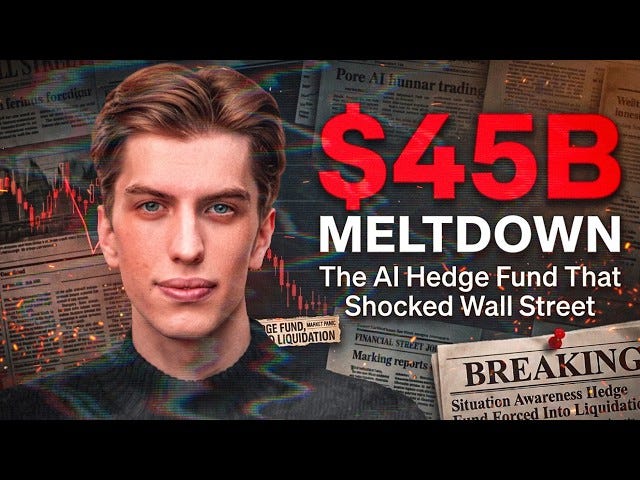
Some investment failures begin with a bad thesis. Others begin with a compelling thesis, executed through a structure that cannot survive the journey.
The recent crisis at Leopold Aschenbrenner’s hedge fund, Situational Awareness, appears to belong to the second category.
Aschenbrenner is not the conventional Wall Street fund manager. Born in Germany, he entered Columbia University at 15, graduated as the top student in his economics class, worked on OpenAI’s Superalignment team and later published Situational Awareness: The Decade Ahead—a 165-page essay outlining how advanced artificial intelligence could transform the economy and geopolitics.
His central investment thesis was both ambitious and intellectually coherent: AI would require far more than better algorithms.
It would consume enormous quantities of computing power, semiconductors, memory, electricity, cooling capacity and data-center space. If AI development accelerated as he expected, the physical infrastructure supporting it could become one of the most valuable—and constrained—parts of the global economy.
In 2024, Aschenbrenner established a hedge fund bearing the same name as his essay and began investing around that thesis.
The early results were extraordinary.
According to an investor letter cited by multiple news organizations, Situational Awareness generated a net return of 439% during the first half of 2026 and approximately 1,551% since its inception. The firm reportedly grew to more than $20 billion in assets under management.
For a manager in his mid-20s, with limited professional investing experience before launching the fund, this was a remarkable achievement. He had turned a macro-technological insight into one of Wall Street’s most closely watched investment portfolios.
Then the market turned.

A Trade That Came Under Pressure From Both Directions
Situational Awareness reportedly owned companies positioned to benefit from AI infrastructure spending while maintaining short exposure to software businesses it believed could be disrupted or comparatively disadvantaged by AI.
This created two sides to the portfolio:
Long positions in AI infrastructure, memory, power and related assets.
Short positions in selected software companies.
Under favorable market conditions, the strategy offered the potential to profit from both sides of the AI transformation. The fund could benefit as infrastructure companies appreciated and as vulnerable software businesses declined.
But a long-short portfolio is not automatically a hedged portfolio.
When AI-related infrastructure stocks began falling and some of the fund’s software shorts rallied, both sides moved against the fund simultaneously. Instead of one group offsetting the other, the two sources of risk compounded each other.
Leverage made the situation more dangerous.
Leverage increases a fund’s market exposure beyond the capital supplied by its investors. It can magnify returns when prices move in the expected direction, but it also magnifies losses and creates collateral obligations when positions decline.
This distinction is critical.
An unleveraged investor with sufficient liquidity may be able to hold a position through a severe drawdown. A leveraged investor does not necessarily have that option. Prime brokers can demand additional collateral, reduce financing or require positions to be sold.
According to published reports, Situational Awareness worked with Bank of America, Goldman Sachs and JPMorgan Chase to manage collateral demands and reduce its exposure. On July 30, 2026, the fund sold its public-equities portfolio to Ken Griffin’s Citadel in a large, urgently arranged transaction.
The firm reportedly retained private investments, including an interest in Anthropic. Therefore, describing the event as a complete loss of the fund would be inaccurate. Nevertheless, the forced disposal of its public portfolio represented an extraordinary reversal for a firm that had recently reported exceptional returns.

Why Did the Strategy Fail?
The easiest explanation would be to say that Aschenbrenner was wrong about AI.
That conclusion is premature.