

An Operational Excellence perspective | "SPIRIT AIRLINES: WHEN THE ULTRA LOW COST MODEL LOST ITS OPERATIONAL FOUNDATION"
From an Operational Excellence (Master Black Belt) consulting perspective.

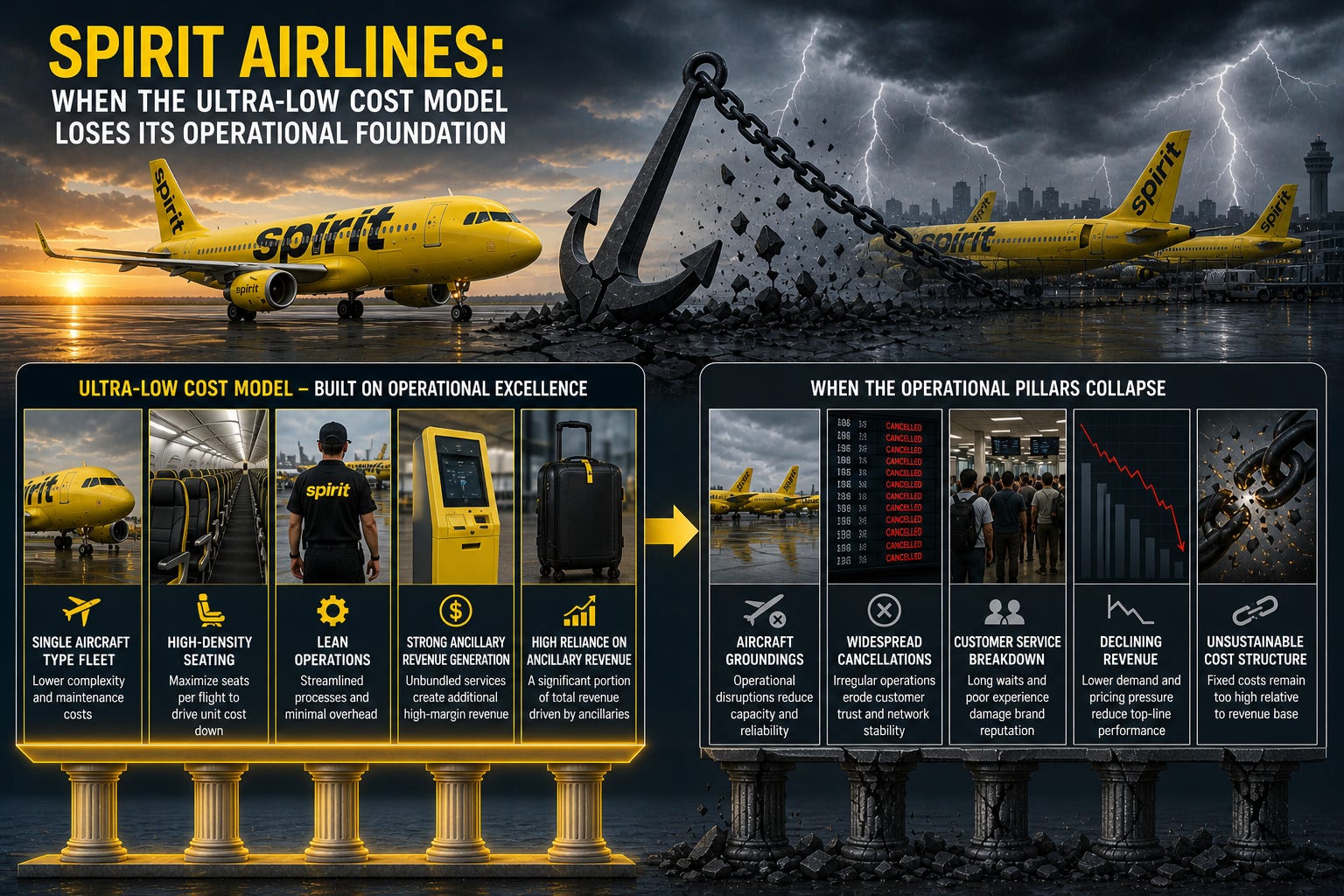
On May 2, 2026, at 3:00 AM Eastern Time, Spirit Airlines officially ceased all flight operations. 17,000 people, including 14,000 full time employees and thousands of subcontractors, received notification just one hour before the decision was publicly announced. This marked the first major airline shutdown in the United States since Midway Airlines ceased operations following the events of September 11, 2001. The story of Spirit Airlines is not merely a routine bankruptcy in the aviation industry, but rather a profound lesson in how an operating system, no matter how lean its design, can still collapse when its foundational assumptions are simultaneously broken from multiple directions.
From an Operational Excellence standpoint, this article does not aim to judge or assign responsibility to any individual or organization. Instead, it will analyze Spirit Airlines’ 43 year journey entirely through an operational lens, exploring how operational variables interact with one another, how single variable optimization can create blind spots, and how operational resilience plays a decisive role in an enterprise’s survival. The sole objective is to extract valuable insights for any organization operating in a high volatility environment.
THE ORIGINS AND OPERATING PHILOSOPHY OF SPIRIT AIRLINES
Spirit Airlines began under the name Charter One Airlines in 1983, operating as a charter flight service in the Detroit, Michigan area, spun off from the Clippert Trucking Company. For nearly its first decade, the airline served short and medium haul routes on a small scale, focusing on the price sensitive leisure traveler segment with destinations including Las Vegas, Atlantic City, and the Bahamas. In May 1992, the carrier officially rebranded as Spirit Airlines and transitioned to a scheduled airline model, marking its first major turning point.
The most significant transformation came under CEO Ben Baldanza (2006 to 2015), when Spirit Airlines became the first and purest Ultra Low Cost Carrier (ULCC) in the United States. The operating philosophy of the ULCC model can be understood through one core principle: completely unbundling the base fare from all ancillary services (the “Bare Fare” unbundling model introduced in 2007), thereby driving ticket prices to the lowest possible level to attract the most price sensitive customer segment. Every service, from checked baggage, carry on luggage, seat selection, food and beverages, to printing a boarding pass at the airport, became a separately charged source of ancillary revenue. This model drove Spirit’s ancillary revenue above 40% of total revenue under Baldanza, and it continued climbing to approximately 50 to 59% by 2024 (per IdeaWorks data), one of the highest ratios in the global airline industry.
From an operational perspective, Spirit’s ULCC model was built on several clearly defined pillars. The first was optimizing Cost per Available Seat Mile (CASM). Spirit maintained the industry’s lowest CASM by operating a single fleet type (fleet commonality) of Airbus A320 family narrowbody aircraft, maximizing seat density per aircraft, minimizing turnaround time at the gate, and eliminating any cost not directly tied to moving passengers from point A to point B. The second pillar was maximizing fleet capacity by increasing average daily flight hours per aircraft (aircraft utilization), thereby spreading fixed costs (depreciation, leases, insurance) across more flights. The third was a point to point network structure rather than the traditional hub and spoke model, reducing hub airport operating costs and minimizing aircraft ground time.
This philosophy, from a purely operational standpoint, is a textbook example of single variable optimization: unit cost. Spirit Airlines engineered itself into a precision calibrated operating machine designed to perform most efficiently within a very specific set of conditions: stable fuel prices in the low to mid range, strong demand from price sensitive travelers, high fleet utilization rates, and limited direct price competition from legacy carriers. When all these conditions were met, the thin margin, high volume operating model proved its strength for many years. However, this deep optimization along a single dimension simultaneously created a systemic vulnerability that only became apparent when boundary conditions shifted.
THE CASM/RASM DIVERGENCE: THE FIRST SIGN OF OPERATIONAL STRESS
To understand Spirit Airlines’ collapse, it is essential to analyze the two most critical operating metrics in the airline industry: CASM (Cost per Available Seat Mile) and RASM (Revenue per Available Seat Mile). The relationship between these two metrics determines the operating margin, and when the gap between them narrows or reverses, it represents the earliest warning signal that any operations professional should monitor closely.
Since Q1 2019, Spirit Airlines’ CASM increased by approximately 40%, nearly double the rate of inflation. This figure reflects simultaneous cost escalation across multiple categories: post pandemic fuel price volatility, rising labor costs driven by new industry wide collective bargaining agreements, increased maintenance costs from fleet aging and particularly from the engine recall event, and higher aircraft lease rates due to a tightened leasing market. Specifically, adjusted CASM excluding fuel rose from approximately 5.67 cents in Q4 2019 to 7.97 cents in full year 2024. Meanwhile, RASM increased by only approximately 8% over the same period, a growth rate less than half the general inflation rate. In absolute terms, by year end 2024, Spirit’s RASM stood at 9.27 cents while CASM had risen to 11.35 cents, meaning Spirit was spending more than it earned on every available seat mile.
The root causes of this CASM/RASM divergence lay on both sides. On the cost side, many factors were beyond the airline’s direct control: fuel pricing is a global variable, labor costs are driven by industry wide pressures, and maintenance costs depend on engine manufacturers. However, on the revenue side, the stagnation of RASM reflected a structural shift in the competitive landscape. U.S. legacy carriers successively introduced Basic Economy fares (pioneered by Delta Air Lines in 2012, followed by American Airlines and United Airlines), essentially replicating Spirit’s stripped down service model but layered onto a broader route network, a stronger loyalty program, and a more established brand reputation. When a passenger could purchase a Basic Economy fare on American or Delta for only marginally more than Spirit’s price, but fly on a carrier with a wider connecting network and lower risk of service disruption, Spirit’s price advantage was severely eroded.
From an operational perspective, this represents a phenomenon of “reverse commoditization”. Typically, premium products are commoditized when low cost competitors enter the market. In this case, however, legacy carriers commoditized the low cost product itself, creating a “good enough” cheap version of precisely what Spirit was selling, while retaining systemic advantages Spirit could not match. The result was that Spirit lost its ability to grow RASM (because the market would not accept higher prices for a ULCC product when comparable alternatives existed) while still bearing rising CASM (because operating costs are carrier agnostic).
This divergence did not happen overnight. It accumulated gradually from 2019, intensified through the Covid 19 pandemic period, and by 2024 the gap had widened to the point where Spirit’s operating margin turned deeply negative. In 2024, Spirit’s total operating revenue was $4,913.4 million, down 8.4% year over year, while the airline recorded a net loss of $1,229.5 million (approximately $1.2 billion). These figures demonstrate that the operating model had lost its ability to self balance.
THE PRATT & WHITNEY GTF ENGINE EVENT AND ITS IMPACT ON OPERATING CAPACITY
If the CASM/RASM divergence represented chronic stress, the Pratt & Whitney GTF (Geared Turbofan) engine recall was an acute shock that struck directly at Spirit’s operating capability. This is a textbook case of how single source dependency on a critical equipment supplier can create systemic operational risk.
Spirit Airlines operated a fleet including Airbus A320neo and A321neo aircraft powered by Pratt & Whitney PW1100G JM engines from the GTF family. In July 2023, parent company RTX identified issues related to a powdered metal manufacturing defect in the high pressure compressor disk, triggering a large scale global inspection and replacement program. For Spirit, the direct consequence was 38 narrowbody Airbus aircraft grounded, with all 79 GTF engines in the fleet falling within the scope of the recall. Over 50% of Spirit’s fleet consisted of A320/A321neo aircraft using GTF engines, making the airline especially vulnerable.
The operational impact can be measured through aircraft utilization: from 11.1 block hours per day per aircraft in 2023, this figure dropped to 9.9 hours in 2024. A decline of 1.2 hours per day per aircraft may seem modest, but when multiplied across the entire fleet over a full year, it represents millions of lost Available Seat Miles (ASMs). For a ULCC operating on thin margins, every hour an aircraft sits on the ground without generating revenue constitutes a significant opportunity cost, since fixed costs (depreciation, lease payments, insurance) continue to accrue regardless of whether the aircraft flies.
The cascading effects across the entire operating chain were substantial. Spirit was forced to furlough 170 pilots effective September 1, 2024 due to insufficient aircraft to maintain the flight schedule, followed by approximately 300 additional pilots from January 2025. This not only affected labor costs but also created operational risk when schedule recovery became necessary: pilots returning from extended leave require recurrent training and proficiency checks before returning to line operations, introducing lag time into the capacity recovery process. Compensation from Pratt & Whitney (through its subsidiary International Aero Engines, or IAE) amounted to approximately $150 to $195 million (some sources cite up to $200 million), but monetary compensation could not offset the flights not flown, the ancillary revenue not generated, and the degradation in customer experience from cancellations and schedule disruptions.
From an operational standpoint, the GTF event exposed a critical characteristic of Spirit’s operating system architecture: fleet commonality, widely regarded as a strength, becomes a vulnerability when systemic risk materializes. When an entire fleet relies on a single engine type from a single supplier, a single quality event can impact the airline’s entire operating capacity with no backup fleet using alternative powerplants available as a substitute. This is the classic efficiency versus resilience trade off in operating system design, and Spirit had prioritized efficiency to the maximum extent.
THE BLOCKED MERGER AND THE ABSENCE OF AN ALTERNATIVE PATH
In July 2022, JetBlue Airways proposed acquiring Spirit Airlines at an equity value of $3.8 billion (adjusted enterprise value of $7.6 billion). From a purely operational perspective, this transaction would have created the fifth largest airline in the United States with complementary route networks: JetBlue’s strength in major East Coast airports and transcontinental routes paired with Spirit’s strength in short to medium haul routes and secondary airports. The combination could have addressed Spirit’s RASM challenge (through JetBlue’s broader network connectivity and stronger brand) while helping JetBlue reduce CASM (through greater fleet scale and Spirit’s low cost operating expertise).
On January 16, 2024, a federal judge blocked the transaction on grounds that it would likely raise fares and reduce competition. Regardless of the rationale, the operational consequence was clear: Spirit lost its restructuring through merger pathway, an option that many ULCCs globally have successfully used when the standalone model is no longer sustainable. More critically, Spirit had devoted nearly two years (2022 to 2024) of management bandwidth and organizational energy to pursuing the merger, while fundamental operational issues (the CASM/RASM divergence, the engine event, the competitive landscape shift) continued to compound. When the merger was blocked, Spirit had to confront all of these deferred issues simultaneously, but now with weaker financial resources and a diminished market position.
This represents a critical operational lesson: when an organization commits its entire exit strategy to a single contingency (single exit strategy) and that contingency fails, the organization typically ends up in a worse position than before it began pursuing the option, because time and resources have been consumed while root cause issues remained unaddressed. In operations management, the principle of parallel contingency planning exists precisely to avoid this scenario. That said, it must be acknowledged that simultaneously pursuing a merger and deep operational restructuring is extremely challenging from a governance and resource allocation standpoint, particularly for an organization of Spirit’s scale.
THE FIRST BANKRUPTCY AND THE QUESTION OF OPERATIONAL RESTRUCTURING
On November 18, 2024, Spirit Airlines filed for Chapter 11 bankruptcy protection for the first time. The airline spent 87 days in the bankruptcy process before emerging in March 2025. In terms of timeline, 87 days is a notably swift process, made possible because Spirit had negotiated a pre-negotiated restructuring framework with the majority of its bondholders prior to filing.
However, from an operational perspective, the most notable characteristic of this first restructuring was its scope: it was primarily a balance sheet restructuring, focused on converting secured bond debt into equity (debt for equity swap) of the reorganized company. The core operational questions, including whether the ULCC business model remained viable in the new competitive landscape, whether the cost structure required fundamental change, whether the fleet strategy needed adjustment, and to what degree fuel risk management capabilities should be built, were not addressed to the necessary depth.
This created a paradox: Spirit emerged from bankruptcy with a cleaner balance sheet but with the same operating model that had led to bankruptcy. If the operating model is likened to an organization’s operating system, then the first restructuring was akin to clearing junk files to free up memory without updating or patching the operating system itself. The computer runs faster temporarily, but the underlying bugs persist and will resurface.
Actual results confirmed this: in just three months from March to June 2025 following its Chapter 11 emergence, Spirit continued to lose an additional $257 million (versus the plan’s projected net income of $252 million for all of 2025). These figures demonstrate that the problem did not lie in the financial structure but in the operating structure and business model. A clean balance sheet serves no purpose when the enterprise continues to operate with CASM systematically exceeding RASM.
THE SECOND BANKRUPTCY AND A RESTRUCTURING PLAN BUILT ON A SINGLE VARIABLE ASSUMPTION
On August 29, 2025, Spirit Airlines filed for Chapter 11 bankruptcy protection for the second time, less than one year after the first. This time, the scale of the problem was significantly larger: total liabilities of $8.1 billion versus total assets of $8.6 billion (per court filings), meaning the safety cushion between assets and liabilities was only approximately $500 million, an extremely thin margin for an airline with billions of dollars in annual operating costs.
The second restructuring plan was built around a critical foundational assumption: jet fuel priced at $2.24 per gallon for 2026 and $2.14 for 2027 (per the SEC filing from March). At this price level, combined with other operational adjustments, Spirit could achieve a positive operating margin of approximately +0.5% at the point of emergence. In other words, the entire recovery plan depended on the assumption that fuel prices would remain at or below historical average levels.
From an operational analysis perspective, this is a point requiring careful examination. Jet fuel is the highest volatility variable in any airline’s cost structure, typically representing 25 to 35% of total operating costs. Building a recovery plan with a margin of only 0.5% based on an assumption about the most volatile cost variable, without meaningful fuel hedging mechanisms in place, means the plan is viable only within a very narrow scenario band. Any event pushing fuel prices above the assumed level would wipe out the margin entirely and return the airline to loss making territory.
This is not a critical observation but rather a structural assessment of the plan’s design. In practice, airlines undergoing bankruptcy have very limited access to the fuel derivatives market on favorable terms, given low credit standing and a lack of collateral. However, this very constraint underscores the importance of designing restructuring plans with multi-scenario planning, including adverse scenarios, and defining the breakeven thresholds at which the plan would need to be adjusted.
THE STRAIT OF HORMUZ CRISIS AND THE EXOGENOUS SHOCK
The event that fundamentally changed the situation was the Strait of Hormuz crisis. Beginning on February 28, 2026, when military conflict erupted in the region, oil shipments through the strait were severely disrupted, creating what analysts termed a “dual blockade”. Approximately 20% of the world’s seaborne crude oil transits the Strait of Hormuz, and this disruption was immediately reflected in crude oil and jet fuel prices.
Jet fuel prices surged approximately 95% since the conflict began, reaching approximately $4.51 per gallon by the end of April 2026, more than double the $2.24 assumption in the restructuring plan. According to J.P. Morgan analysis, if fuel prices sustained at the $4.60 per gallon level, the projected +0.5% operating margin would instantly swing to negative 20%. The estimated incremental fuel cost was approximately $360 million per year, a figure the airline had absolutely no capacity to absorb.
It is important to place Spirit’s situation within the broader industry context. The Hormuz crisis impacted every airline, not just Spirit. However, the impact was asymmetric. Major carriers with operating margins of 8 to 12%, with fuel hedging programs covering 30 to 50% of requirements, with financial resources to absorb short term shocks, and with pricing power from less price sensitive customer segments, were able to weather the high fuel price period without existential threat. Spirit, with near zero margins, no fuel hedge, financial resources depleted after two bankruptcies, and an extremely price sensitive customer base (unable to raise fares meaningfully without losing passengers), was pushed to the breaking point.
From a systems perspective, the Hormuz event is an example of an “exogenous shock”, the type of event that falls outside the normal probability distribution used for planning purposes. However, for the airline industry, geopolitical events affecting oil prices are hardly rare occurrences. The 1973 oil crisis, the Gulf War of 1990 to 1991, September 11, the 2008 financial crisis, the Covid 19 pandemic, each decade has produced at least one major disruption event for the industry. Therefore, the question is not whether unexpected events will occur, but whether the operating model has sufficient flexibility to absorb the impact when they do. In Spirit’s case, the answer was no, and this reflects operating structure rather than bad fortune.
THE FINAL CHAPTER AND THE DISSOLUTION OF THE OPERATING SYSTEM
Following the fuel price surge, Spirit Airlines sought a federal bailout of $500 million in the form of a government loan convertible into an equity stake of up to 90% in the airline. However, the bondholders rejected the terms because the arrangement would subordinate existing creditor claims to the government’s position. The bailout was not approved. With revenue insufficient to cover operating costs at current fuel price levels, no additional financing available, and uncertain prospects for a rapid fuel price decline, Spirit’s leadership made the decision to cease operations.
The manner of the shutdown itself contains notable operational lessons. The notification of 17,000 employees just one hour before the decision was announced (the Association of Flight Attendants, or AFA, leadership sent word to 5,000 members at Spirit at approximately 1:00 AM Eastern Time) reflects the urgency of the situation and simultaneously reveals the limits of transition planning capability when an organization is in a state of acute crisis. Under ideal circumstances, an orderly wind down allows time to support employee transitions, fulfill obligations to ticketed passengers, and preserve the value of transferable assets. However, when an enterprise is losing money every day it continues to operate, each day of delay in ceasing operations means additional financial losses, creating pressure for rapid action.
Spirit Airlines’ shutdown also generated ripple effects across the entire U.S. aviation system. Hundreds of thousands of passengers holding Spirit tickets needed to be re-accommodated on other carriers. Airports where Spirit held a significant share of capacity, particularly Fort Lauderdale Hollywood International Airport (FLL), where Spirit had been the largest airline with approximately 65 daily domestic departures, suddenly lost a substantial portion of traffic. JetBlue promptly announced 11 new routes from Fort Lauderdale to fill the gap. Aviation workers, especially pilots and flight attendants with specialized certifications, entered the labor market simultaneously, creating both opportunities (for airlines actively hiring) and challenges (for the workers themselves navigating the transition).
ANALYSIS FROM AN OPERATIONAL EXCELLENCE PERSPECTIVE
Looking back at Spirit Airlines’ entire trajectory, the picture that emerges is not simply an airline that went bankrupt, but an operating system that underwent process capability degradation over many years before ultimately failing. Collapse is never sudden for those who understand how to read the signals a system produces.
The confusion between “operational efficiency” and “operational health”.
This is the most common cognitive error in operations management practice, and Spirit Airlines is its clearest illustration. Within Operational Excellence thinking, there is a fundamental distinction between two concepts that many organizations conflate. Operational efficiency answers the question: “Is the organization minimizing waste within its current processes?” Operational health answers the question: “Does the operating system have the capability to sustain acceptable performance across multiple cycles of volatility?”
Spirit Airlines scored extremely high on operational efficiency. A uniform fleet, industry lowest CASM, minimal turnaround time, maximum seat density, every process lean to the point where virtually nothing remained to cut. But operational health was an entirely different story. Operational health can be understood as an organization’s immune system. A person may be able to run very fast (high efficiency) but if the immune system is compromised, an ordinary cold can lead to serious complications. Spirit ran faster than any airline on a straight track, but the airline’s operational immune system, its ability to withstand and recover from shocks, had deteriorated to a critical level.
When assessing the operational health of any organization, the focus should be on five leading indicators, signals that reveal the system will encounter problems before problems actually manifest, as distinct from lagging indicators such as profit, revenue, or on time performance, which only report what has already occurred. These five indicators include: capacity reserve margin (what percentage of capacity can be lost before the system ceases to function), cost adaptability speed (when revenue drops 10%, how quickly and by how much can costs adjust), risk source diversification (how many independent variables could independently cause systemic failure), financial buffer depth (how many months can the organization survive at zero revenue), and organizational learning capability (how quickly can the organization change its processes upon recognizing a problem). Applying these five indicators to Spirit as of 2023, before any major shock had occurred, the result would have been red alert status on nearly every measure.
The local optimization trap and the phenomenon of “sub-optimization”.
Within systems thinking, there is a principle that Dr. W. Edwards Deming emphasized repeatedly in his System of Profound Knowledge: optimizing individual components of a system does not lead to optimization of the whole system, and in many cases, it makes the overall system worse. This is the phenomenon of sub-optimization.
Spirit Airlines excelled at optimizing each individual component: fuel cost per ASM minimized through a new, efficient fleet; labor cost per ASM controlled through high workforce productivity; distribution costs reduced through direct sales; airport costs reduced through short turnaround times. But when viewed as a total system, this component level optimization produced a rigid system lacking the capacity for self adjustment. Every component was already running at the upper limit of its design capacity, leaving no slack to compensate when another component encountered problems.
The most intuitive analogy is a race car calibrated for maximum speed on a specific track, with tire pressure, gear ratios, wing angles, and fuel load all optimized for precisely that track, at that air temperature, at that humidity level. The car will outperform every competitor on that track. But if it rains, or the track layout changes a corner, or the temperature shifts by 10 degrees, the hyper optimized car will lose competitiveness faster than a car calibrated to perform “well enough” across multiple conditions. This is the precise paradox Spirit encountered: the airline was the fastest car on a dry track, but it had been raining since 2019, and the rain only grew heavier.
“Common cause” versus “special cause” variation: reading the signals from the system.
One of the core competencies of a Master Black Belt is the ability to distinguish between common cause variation and special cause variation in operational data. Common cause variation is the inherent variation within a system, falling within control limits, and can only be reduced by changing the system itself. Special cause variation is variation caused by a specific, identifiable event that falls outside normal control limits.
Applying this lens to Spirit Airlines, two types of variation operating simultaneously become clear. Common cause variation includes the gradual CASM/RASM divergence, the gradual erosion of competitive advantage as legacy carriers rolled out Basic Economy, the gradual industry wide labor cost escalation, and the gradual post pandemic shift in consumer behavior as passengers began placing greater value on reliability and experience. These are structural trends, not caused by any specific event but rather by the natural evolution of the market. Addressing common cause variation requires changing the system, meaning changing the business model, redesigning the value chain, or repositioning the brand.
Special cause variation includes the P&W GTF engine event, the blocked JetBlue merger, and the Strait of Hormuz crisis. These are specific, identifiable events with clear impact. Addressing special cause variation requires isolating and treating the specific root cause.
The most common strategic error, what Deming called “tampering”, occurs when an organization responds to common cause variation with special cause treatment, or vice versa. In Spirit’s case, the first Chapter 11 restructuring can be analyzed through this framework: the airline treated the financial consequences (a symptom) with a balance sheet restructuring (a special cause intervention), while the actual problem was a structural shift in the market and business model (a common cause) requiring comprehensive system change.
Value Stream Thinking and the evolving definition of “value” in the customer’s eyes.
A foundational question when analyzing any operating system is: “Is the customer’s definition of value changing, and is the operating system changing with it?” Spirit Airlines defined customer value as the lowest possible ticket price and built its entire value chain around that definition. This was entirely logical at the time the model was designed.
But the customer’s definition of “value” is not a constant. After the Covid 19 pandemic, U.S. air travel consumer behavior underwent notable shifts. Customers began evaluating the total cost of experience rather than ticket price alone. Total cost of experience includes: the base fare plus baggage fees, seat selection fees, and food charges, plus risk cost (the probability of cancellation, delay, lost baggage, and having to self manage during disruptions), plus opportunity cost (no mileage accrual, no loyalty membership benefits, no flexible rebooking support). When legacy carriers sold Basic Economy fares priced only $15 to $25 higher than Spirit but bundled with a wider connecting network, frequent flyer programs, and disruption support, the total cost of experience on a legacy carrier was actually lower than Spirit in many scenarios, despite the nominally higher ticket price.
This carries profound operational implications. When customers change how they define value, but the operating system remains optimized around the old value definition, the system is producing something the market is increasingly unwilling to pay for, regardless of how efficiently it is produced. Efficiently producing something that customers no longer want to buy is the greatest form of waste in lean operational thinking: strategic level overproduction waste.
Single source supply chain and the concept of “single point of failure” at the systems level.
When analyzing Spirit’s dependency on the Pratt & Whitney GTF engine, many observers see it as a straightforward supplier issue. But from a Master Black Belt perspective, this is a symptom of a deeper problem: Spirit had too many single points of failure across its entire operating system.
The list of single points of failure includes: one engine type only (PW1100G JM), one aircraft manufacturer only (Airbus), one business model only (pure ULCC), one primary customer segment (highly price sensitive), one primary source of competitive advantage (lowest price), and one primary geographic market (U.S. domestic and Caribbean). Each “one” in this chain is a single point of failure. In reliability engineering, the fundamental principle is: the overall reliability of a series system equals the product of the reliabilities of each component. With six components in series, each with 90% reliability (meaning a 90% probability of normal operation in any given cycle), the overall system reliability is 0.9 to the power of 6, or approximately 53%. This means the system has nearly a 50% probability of encountering at least one failure in any given cycle. This is not abstract mathematics but rather the reality Spirit experienced when multiple single points of failure triggered problems simultaneously.
Reinforcing feedback loops and the “acceleration of decline”.
A critical feature of Spirit’s collapse that must be identified is the formation of reinforcing feedback loops (positive feedback loops) operating in a negative direction, meaning each problem made other problems worse, creating an accelerating decline effect.
The specific chain of impact: GTF event → reduced fleet capacity → fewer flights → reduced revenue → cost cutting → reduced service quality → lower load factor → further revenue decline → difficulty attracting investment capital → no funds for fuel risk mitigation → greater vulnerability to fuel price volatility → when fuel prices spike, impact is more severe → deeper losses → insolvency. Once initiated, this loop is extremely difficult to break because every effort to address one problem is undermined by the other problems within the loop.
In systems thinking, the only way to break a reinforcing feedback loop operating in a negative direction is to intervene at the system’s leverage point, the point where a small change can produce the greatest impact on the entire loop. For Spirit, the leverage point likely resided in the business model (transitioning from a pure ULCC to a hybrid model with a more diversified customer segment), but changing the business model while caught in a decline spiral requires resources the airline no longer possessed. This is a situation that in consulting practice is called a “closed intervention window”: the point at which change could have generated a positive impact has passed, and the organization is left only with less bad options rather than good ones.
The “yesterday’s optimized enterprise” problem.
There is a useful concept when analyzing organizations in distress: the “yesterday’s optimized enterprise”. This describes a state in which an organization has built a perfect operating system for a business environment that no longer exists. Every process, every capability, every organizational structure has been designed for a reality that has passed, and the opportunity cost of maintaining the old system grows increasingly larger than the benefit it delivers.
Spirit Airlines was the optimized enterprise for the 2007 to 2019 period, when fuel prices were relatively stable, when Basic Economy from legacy carriers did not yet exist, when American travelers were in the process of shifting toward a “pay for what you need” mindset, and when ULCC segment competition was limited. By 2023, each of these conditions had changed, but the operating system was still designed for the old context.
The deeper lesson here is not that Spirit was wrong to build the ULCC model. That model was entirely correct for its time and context. The lesson is: every operating model has a “design life”, just like bridges, machinery, or any engineered system. When the design life expires, not because the system has broken, but because the conditions the system was designed to operate within have changed sufficiently, the system needs to be redesigned rather than merely maintained or further optimized. Continuing to optimize a model that has exceeded its design life is like perfectly maintaining a typewriter in the age of computers: the typewriter may run better than ever, but no one needs it anymore.
REFLECTIONS ON OPERATING SYSTEM DESIGN IN HIGH VOLATILITY ENVIRONMENTS
Building on the analysis above, the following seven reflections are offered for any operations leader managing an organization in a high volatility environment. These are not theoretical propositions but rather lessons drawn from the Spirit Airlines case, placed within the broader context of Operational Excellence practice.
Reflection one: Measure “distance to failure” rather than current performance alone.
The majority of operational dashboards across organizations focus on current performance: today’s revenue, this month’s costs, this quarter’s profit. Very few organizations measure and track the distance from the current state to the failure point (distance to failure). The failure point is the threshold at which the system loses its ability to self recover: “How much further can fuel prices rise before the operating margin turns negative?”, “What percentage of the fleet can be grounded before the route network begins to collapse?”, “How many months can the organization sustain continuous losses before liquidity is exhausted?” Had Spirit routinely measured and reported distance to failure across its critical variables, leadership would have seen that distance shrinking each quarter, creating the impetus to act earlier, while the intervention window remained open.
Reflection two: Build “operational switchability” as a core capability.
Most organizations build core competencies around operating the current model (doing what they already do, better). Very few build core competencies around transforming the model (shifting from one way of operating to another). The concept of “operational switchability” refers to the capability to move between different operating modes depending on environmental conditions.
In the airline industry, a worthwhile benchmark is Ryanair in Europe, also a ULCC but one that has built stronger switchability than Spirit. Ryanair maintains a fuel hedging program covering up to 80% of requirements over the next 12 months, allowing the airline to switch between “low fuel price” and “high fuel price” modes without shock. Ryanair also maintains a low debt to equity ratio, creating a financial buffer to absorb shocks. And most importantly, Ryanair operates in the European market where ULCC competitive dynamics differ from the United States, demonstrating that the same operating model in a different ecosystem context can produce different outcomes.
Reflection three: Distinguish between “value creating savings” and “savings borrowed from the future”.
Not all cost savings are equivalent. In Operational Excellence, there is a fundamental difference between value creating savings (eliminating genuine waste, improving processes, enhancing productivity) and savings borrowed from the future (deferring maintenance, reducing training, cutting reserves, forgoing fuel hedging). The first type makes an organization stronger over time. The second type makes an organization appear stronger today while accumulating “operational debt”, analogous to the concept of “technical debt” in software development, meaning hidden costs that must be repaid in the future, typically at a much higher rate than the original savings.
When Spirit Airlines did not build a meaningful fuel hedging program, this was a form of immediate cost saving (no derivative contract premiums to pay) but simultaneously a loan taken from the future (accepting full exposure to fuel price volatility). When the future arrived in the form of the Hormuz crisis, that debt “came due” at an extremely high “interest rate”.
Reflection four: Financial restructuring does not substitute for operational restructuring.
This lesson warrants emphasis because it is so prevalent. In practice, the majority of restructurings over-index on the financial dimension and under-index on the operational dimension. The reason is simple: financial restructuring delivers immediately measurable results (reduce X billion in debt, save Y million in annual interest), while operational restructuring delivers results that are distributed over time and difficult to quantify in advance. Under pressure from bankruptcy courts, creditors, and the clock, organizations naturally gravitate toward the solution that delivers quick results. But if the root cause lies in the operating model, then financial restructuring is like pain relief without treating the disease: the patient feels better temporarily, but the condition continues to progress.
Reflection five: “Resilience capability” is an investment, not a cost.
When an organization maintains spare capacity, diversifies suppliers, builds hedging programs, or holds cash reserves above what is needed for day to day operations, these actions are commonly perceived as “costs” because they generate no direct value under normal conditions. But this perception requires adjustment. Resilience capability is a form of operational insurance, and like insurance, its value only becomes apparent when an adverse event occurs.
The correct way to evaluate the value of resilience is to calculate across the full cycle, including both normal years and crisis years, rather than evaluating within a single normal year alone. If maintaining resilience capability costs 2% of revenue annually over 10 years (a cumulative 20% of revenue), but it prevents an event that could destroy 50% of enterprise value, then it is an investment with a clearly positive return. Spirit Airlines saved on hedging costs, reserve costs, and diversification costs for many years, but when the shock arrived, the cumulative savings amounted to a fraction of the total loss.
Reflection six: “Reactive culture” versus “preventive culture”.
Two types of operational culture must be distinguished. A reactive culture is one in which the organization excels at responding after incidents occur: mobilizing teams, rapid analysis, developing solutions, remediating consequences. A preventive culture is one in which the organization invests in identifying and preventing problems before they occur: continuously monitoring leading indicators, conducting periodic scenario analysis, building early warning systems, and maintaining contingency plans for adverse scenarios. A reactive culture looks impressive from the outside because observers see teams making heroic efforts to resolve crises spectacularly. But a preventive culture, though less “dramatic,” is the culture that produces sustainable organizations over the long term. The best organization is one that never needs heroes, because the system has been designed to handle the majority of contingencies automatically and with a plan.
Reflection seven: People remain at the center of every operating system.
This is the final reflection, but perhaps the most important. The most frequently asked questions in boardroom discussions about Operational Excellence are: “How can costs be reduced further?”, “How can productivity be increased?”, “How can processes be automated?” Far less frequently is the question posed: “How can the operating system better serve all stakeholders, including employees, customers, communities, and investors?”
17,000 people lost their livelihoods as a result of the Spirit Airlines event. This is not a secondary consequence. It is a direct outcome of how the operating system was designed. An operating system designed solely to optimize a single financial metric (CASM, operating margin, share price) while overlooking sustainability for all stakeholders will generate short term value but can destroy long term value on a far greater scale. The ultimate objective of Operational Excellence is not to create the most efficient organization possible, but to create an organization that is both efficient and sustainable, where economic performance and responsibility to people are not opposite ends of a scale, but rather two pillars supporting the same roof.
Truong Ngo, DBA | Lean Six Sigma Master Black Belt | 40 under 40 Operational Excellence professionals recognized by the American Society for Quality (ASQ) in 2021 | Founder at John&Partners: Consulting | Coaching | Training in Operational Excellence.
DISCLAIMER: This article is produced entirely for the purpose of academic analysis and professional knowledge sharing in the field of Operational Excellence. All content is based on publicly available sources including SEC filings, financial reports, and reputable news outlets at the time of writing. The author does not represent any organization, airline, or stakeholder mentioned herein. This article is not intended to criticize, assign blame, provide investment advice, legal counsel, or pass judgment on any individual or organization. All analyses, assessments, and reflections represent a purely operational professional perspective and are for reference purposes only. Figures and data may change as newer information becomes available. The author acknowledges and respects the 17,000 Spirit Airlines employees and their families who were directly affected by this event.
All images are for illustrative purposes only.
REFERENCES
Spirit Airlines — “Spirit Airlines Wikipedia”: https://en.wikipedia.org/wiki/Spirit_Airlines
CBS Detroit — “Spirit Airlines traces its roots to Metro Detroit, where it launched as a charter service in 1983”: https://www.cbsnews.com/detroit/news/spirit-airlines-origin-metro-detroit/
AeroXplorer — “The History of Spirit Airlines: From 1983 to Now”: https://aeroxplorer.com/articles/the-history-of-spirit-airlines-from-1983-to-now.php
FundingUniverse — “History of Spirit Airlines, Inc.”: https://www.fundinguniverse.com/company-histories/spirit-airlines-inc-history/
Airways Magazine — “Ben Baldanza: The Spirit of ULCC Innovation in the US”: https://www.airwaysmag.com/new-post/ben-baldanza-spirit-ulcc-innovation-us
Mighty Travels — “Spirit Airlines’ Evolution From Charter Flights to Ultra Low Cost Giant”: https://www.mightytravels.com/2024/08/spirit-airlines-evolution-from-charter-flights-to-ultra-low-cost-giant/
Visual Approach Analytics — “Spirit’s RASM/CASM chasm”: https://visualapproach.io/spirits-rasm-casm-chasm/
Visual Approach Analytics — “Spirit’s RASM/CASM chasm (newsletter)”: https://weekly.visualapproach.io/p/spirits-rasm-casm-chasm
Santiago & Company — “Spirit Airlines and the Anatomy of an Optionality Failure”: https://www.santiagocompany.com/insights/spirit-airlines-and-the-anatomy-of-an-optionality-failure
SimpleFlying — “Spirit Airlines Reports $1.2 Billion Loss For 2024 With Plans For Recovery”: https://simpleflying.com/spirit-airlines-1-billion-loss-2024-plans-recovery/
Aviation News Online — “Spirit Airlines’ 2024 revenues down 8%, received $151 million in credits related to GTF engine issue”: https://aviationnews-online.com/public/article/spirit-airlines-full-year-revenues-down-8
FlightGlobal — “Engine issues and lease terminations among forces driving Spirit’s latest bankruptcy filing”: https://www.flightglobal.com/strategy/engine-issues-and-lease-terminations-among-forces-driving-spirits-latest-bankruptcy-filing/164350.article
Skift — “Spirit Airlines to Receive up to $200 Million for Pratt & Whitney Engine Problems”: https://skift.com/2024/03/29/spirit-airlines-to-receive-compensation-for-pratt-and-whitney-engine-issues/
Aviation A2Z — “Spirit Airlines Gets $150 Million Compensation Amid P&W Engine Problems”: https://aviationa2z.com/index.php/2025/03/04/spirit-airlines-gets-150-million-compensation-from-pw/
SimpleFlying — “Spirit Airlines Backtracks On Plan To Furlough Up To 365 Pilots Next Quarter”: https://simpleflying.com/spirit-airlines-backtracks-furlough-365-pilots/
Airways Magazine — “Spirit Halts Growth Plans, Downgrades, Furloughs Pilots”: https://www.airwaysmag.com/new-post/spirit-halts-growth-downgrades-furloughs-pilots
Justice Department — “Justice Department Statements on JetBlue Terminating Acquisition of Spirit Airlines”: https://www.justice.gov/archives/opa/pr/justice-department-statements-jetblue-terminating-acquisition-spirit-airlines
Holland & Knight — “2025 Aviation Bankruptcy Update”: https://www.hklaw.com/en/insights/publications/2026/02/2025-aviation-bankruptcy-update
CNBC — “Spirit Airlines files for Chapter 11 bankruptcy protection for the second time in a year”: https://www.cnbc.com/2025/08/29/spirit-airlines-chapter-11-bankruptcy.html
NPR — “Spirit Airlines files for bankruptcy for 2nd time in less than a year”: https://www.npr.org/2025/08/30/nx-s1-5522901/spirit-airlines-bankruptcy-filing
Fortune — “Spirit Airlines looked like it was in the clear of reemerging from bankruptcy, but rising fuel costs threaten its exit”: https://fortune.com/2026/04/20/spirit-airlines-bankruptcy-exit-jet-fuel-liquidation/
MMCGInvest — “Spirit Airlines at the Cliff Edge: Assumption Brittleness and the Arithmetic of the April 2026 Plan”: https://www.mmcginvest.com/post/spirit-airlines-at-the-cliff-edge-assumption-brittleness-and-the-arithmetic-of-the-april-2026-plan
Globe and Mail — “Spirit Airlines shuts down after oil price spike derailed restructuring plan”: https://www.theglobeandmail.com/business/international-business/article-spirit-airlines-shuts-down-iran-war-oil-price-spike/
Al Jazeera — “Spirit Airlines begins ‘wind down’, cancels all flights over fuel crisis”: https://www.aljazeera.com/news/2026/5/2/spirit-airlines-begins-wind-down-cancels-all-flights-over-fuel-crisis
CBC News — “Spirit Airlines shuts down, blames cost of fuel due to Middle East war”: https://www.cbc.ca/news/world/spirit-airlines-ceasing-operations-9.7185446
CNBC — “Spirit Airlines shuts down after failing to reach a bailout deal, ending discount travel era”: https://www.cnbc.com/2026/05/01/spirit-airlines-trump-bailout.html
CNN — “Spirit Airlines canceled all flights and is going out of business”: https://www.cnn.com/2026/05/02/business/spirit-to-halt-all-flights
PBS News — “Spirit Airlines goes out of business after 34 years, ceases operations immediately”: https://www.pbs.org/newshour/economy/spirit-airlines-goes-out-of-business-after-34-years-ceases-operations-immediately
NPR — “Spirit Airlines ceases operations after escalating financial struggles”: https://www.npr.org/2026/05/02/nx-s1-5807933/spirit-airlines-ceases-operations-folds
CNBC — “Spirit Airlines’ final hours: ‘Godspeed my friend’ as terminals go dark”: https://www.cnbc.com/2026/05/02/spirit-airlines-shutdown-inside-the-final-hours.html
NPR — “Spirit Airlines shutters after federal bailout falls through”: https://www.npr.org/2026/05/04/nx-s1-5808972/spirit-airlines-shutters-after-federal-bailout-falls-through
Fortune — “Spirit Airlines is ending operations immediately and going out of business after 34 years”: https://fortune.com/2026/05/02/spirit-airlines-bankruptcy-going-out-of-business-flight-refunds-rebooking/
SimpleFlying — “Why Low Cost Airlines Struggle To Compete With Basic Economy Fares”: https://simpleflying.com/low-cost-airlines-vs-legacy-carriers-basic-economy-analysis/
NPR/KPBS — “Spirit Airlines tried to be the Dollar General of the skies. Then the big airlines beat it at its own game”: https://www.kpbs.org/news/economy/2026/04/29/spirit-airlines-tried-to-be-the-dollar-general-of-the-skies-then-the-big-airlines-beat-it-at-its-own-game
Marketplace — “How ultra low cost carriers like Spirit lost customers to the major airlines”: https://www.marketplace.org/story/2026/04/30/how-ultra-lowcost-carriers-like-spirit-lost-customers-to-the-major-airlines
The Points Guy — “JetBlue moves quickly to fill Spirit’s gap, adds 11 routes from Fort Lauderdale”: https://thepointsguy.com/news/jetblue-fort-lauderdale-11-new-routes-spirit-airlines/
Wikipedia — “2026 Strait of Hormuz crisis”: https://en.wikipedia.org/wiki/2026_Strait_of_Hormuz_crisis
Wikipedia — “2026 Iran war fuel crisis”: https://en.wikipedia.org/wiki/2026_Iran_war_fuel_crisis
DDS Finance — "Spirit Airlines Is Dead: How a $5B Carrier Burned Through $930M of Annual Cash":
CNBC — “Spirit Airlines is on shakier ground after avoiding hard decisions in bankruptcy”: https://www.cnbc.com/2025/08/21/spirit-airlines-lessors-bankruptcy.html
